How to build an ofrenda, and what everything on it means
Once a year, a whole country sets a place at the table for its dead and expects them to show up. It is the healthiest thing anybody does about death, and it costs about as much as a bunch of flowers.
An ofrenda is an offering: a home altar built at the end of October for the dead of the family, loaded with the things they loved, so that when they come back to visit they find the table set. It is the heart of Día de Muertos, the Day of the Dead, and it is not a spooky decoration or Mexican Halloween. It is a family remembering specific people by name, out loud, with food.
UNESCO added the tradition to its list of the Intangible Cultural Heritage of Humanity in 2008 (it was first proclaimed in 2003), and its description is better than anything we could write: families “facilitate the return of the souls to Earth by laying flower petals, candles and offerings along the path leading from the cemetery to their homes,” and “the deceased’s favourite dishes are prepared and placed around the home shrine and the tomb.”
Read that again. Their favourite dishes. Not a sealed casket and a printed programme with a sunset on it. Their actual favourite food, on the table, every year, forever.
One thing before anything else. This is a living tradition with Indigenous and Catholic roots that belongs to the people who keep it. Everything below is drawn from Mexican sources, and none of the jokes on this page are about it. The jokes are about the industry that taught the rest of us to do this so badly.
When to put it up
UNESCO puts the festivities at “the end of October to the beginning of November.” The broad pattern, which varies a lot by region, town and family:
- Late October: the ofrenda goes up. Many families have it built by the 31st.
- 31 October to 1 November: the children. Mexico’s National Institute of Indigenous Peoples (INPI) describes a separate ofrenda for the angelitos, the dead children, set out on 31 October, with the children’s souls arriving on 1 November.
- 2 November: the adults. This lines up with the Catholic All Souls’ Day, as 1 November lines up with All Saints’.
- 27 October: pets. This one is newer. Over the last several years Mexican media have widely reported 27 October as the day families put out an ofrenda for their dead animals. It is a popular modern custom, not part of the traditional calendar, and nobody is going to check your paperwork.
If your family or town does it differently, your family or town is right. There is no single correct version, which is part of the point.
What goes on it, and why
The meanings below are from INPI’s own guide to the elements of an ofrenda, and the cempasúchil details are from Mexico’s agriculture ministry (SADER). Not every altar has all of them. Most have most.
The photograph
The person, or people, the altar is for. Pick the photo where they look like themselves, not the formal one. If you are doing several people, they all go up together. Nobody is sorted by rank.
Water
INPI calls water “la fuente de la vida”, the source of life, set out so the souls can quench their thirst after the long trip back. A plain glass of it. That is all.
Salt
The purifying element. INPI says it is there so the body “no se corrompa”, does not decay, on its journey there and back. A small dish or a little mound is traditional.
Candles
The flame stands for light, faith and hope, per INPI, and lights the way home. Votives in glass are the practical choice; see the safety note further down.
Cempasúchil: the marigolds
Tagetes erecta, native to Mexico. The name comes from the Nahuatlcempoalxóchitl, “twenty flowers”, according to SADER, and there is “la creencia de que sus pétalos iluminan el camino de las almas”: the belief that the petals light the road for the souls. That is why you see paths of loose petals running from the door, or from the street, up to the altar. The colour and the strong smell are the point. It is a flower you can find from across a room with your eyes shut.
Mexico grows more than nine thousand tonnes of it a year, per SADER. You are not going to run the country out.
Copal
A tree resin burned as incense. INPI describes it as the element that lifts prayer and praise, and cleans the space. If you cannot get it, the altar still works.
Pan de muerto
INPI calls bread “el ofrecimiento fraternal”, the fraternal offering. Pan de muerto is a soft, sweet loaf, often scented with orange, decorated with strips of dough shaped like bones. Buy it from a Mexican bakery if there is one anywhere near you. It is better than anything you will make on your first try, and the money goes to the people whose holiday it is.
Their food, their drink, their things
This is the part that makes it theirs. Their dish. Their brand of beer, their tequila, their terrible instant coffee, their cigarettes if they smoked. Sweets for the children. A deck of cards, the hat, the glasses, the bloody remote control. INPI’s guide is specific that children’s ofrendas use small-scale everything, food without chilli, white flowers and candles, toys and little breads.
Papel picado, sugar skulls, and the dog
- Papel picado: cut tissue-paper banners strung over the altar. UNESCO lists “paper cut-outs” among the typical handicrafts.
- Calaveras de azúcar: sugar skulls, often with a name written across the forehead. INPI describes them as a reminder that death is always with us.
- The xoloitzcuintle: a little clay or toy dog on children’s altars. INPI says the dog helps the souls cross the river on the way to Mictlán, the place of the dead. Dogs have been doing the hardest emotional labour in the house for a very long time.
Building one at home: the practical version
You do not need a three-tier altar or a budget. People build ofrendas on dressers, bookshelves, the top of the fridge. Here is a simple one that is complete and respectful.
- Pick the surface. A small table or shelf against a wall, out of reach of toddlers, dogs and cats (more on that below). Cover it with a cloth. White is common.
- Put the photo at the centre and the top. Everything else is arranged around them. If the ashes are at home, they belong here too.
- Add the four elements: a glass of water, a small dish of salt, candles, and flowers. That is a real ofrenda already.
- Add the marigolds. Real cempasúchil if you can find it; Mexican grocery stores and many florists carry it in late October. Put some in water, pull the petals off a few and lay a path to the altar.
- Add their things. The food, the drink, the objects. Make the dish they made, or the one they always ordered. This is the step people cry at, which is how you know it is working.
- Add bread, copal and papel picado if you have them.
- Then actually use it. Sit with it. Tell the stories, including the filthy ones. Eat the food afterwards; in many families, sharing out the ofrenda once the visit is over is part of the tradition.
Total cost: a candle, some flowers, a loaf of bread and whatever their favourite thing was. Compare that with what an American funeral home will charge you for a single viewing room for two hours.
The safety bit, because candles and pets
- Never leave a lit candle unattended, and keep flames well away from papel picado, which is tissue paper and goes up instantly. Battery candles are fine. The dead do not check.
- Cats will investigate the altar. They will drink the water, lick the salt and knock the candle over, not necessarily in that order. Build it high, or in a room you can close.
- Per the ASPCA, eating any plant material may cause vomiting and stomach upset in dogs and cats. If one gets into the flowers or the food and seems wrong, the ASPCA Animal Poison Control line is (888) 426-4435 (a consultation fee may apply).
An ofrenda for a pet
It is the same altar, smaller. The photo. Their collar or tag. A little bowl of their actual food, a bowl of water, the toy that got destroyed and replaced six times. Marigolds and a candle. If their ashes are home, they sit with the photo. If you want the 27 October date, use it; if you want to put them on the family altar next to your grandmother, plenty of people do that too.
We have written a lot on pet death, and the thing we keep coming back to is that people are given no ritual at all for it. You lose the animal who was in the room every day for fifteen years and you are expected to be at work on Monday. A small altar once a year is a ritual, and nobody gets to tell you it is too much for a dog.
If it is not your tradition
Plenty of people who are not Mexican, and did not grow up with this, find it and recognise something they badly needed. That is not a crime. Here is how to come at it without being a tourist:
- Build it for your actual dead. An ofrenda is for specific people you loved. It is not a seasonal look for the mantelpiece or a party theme.
- Learn it from Mexican sources. Mexican and Mexican American museums, cultural centres and community groups across the US put up public ofrendas every year. Go and look, and go to the events. Many of them welcome you to bring a photo.
- Buy from the people whose holiday it is. The bakery, the florist, the papel picado maker. Not the big-box “Day of the Dead décor” aisle.
- Do not make it a costume. Skull face paint on 31 October with nobody in mind is Halloween wearing somebody else’s grief.
- Keep your own beliefs out of the explanation. You do not have to believe the dead literally come back to set a place for them. You do have to not explain the tradition to the people who keep it.
Why the funeral industry should be embarrassed by this
The American way of death, as the industry sells it, goes like this: a stranger takes the body away, a stranger embalms it so it can be looked at for one afternoon, everyone speaks in a special voice for a week, and then the subject is closed. Bring it up at Christmas and somebody changes the conversation. Your grief is a problem to be resolved, ideally by a pre-paid package.
Día de Muertos runs on the opposite assumption: that the dead stay part of the family, that you are supposed to keep talking about them, and that the right response to death is a party once a year with their favourite food, in public, with music, for the rest of your life. It costs almost nothing and nobody makes a margin on it. If you wanted proof that the hushed beige version is a business model and not a law of nature, here it is.
And a footnote to show how hard the culture industry can get this backwards: the giant Day of the Dead parade through central Mexico City, the one everybody has seen photos of, did not exist until 2016. It was created after the 2015 James Bond film Spectre opened with one that the filmmakers had invented. The ofrenda in a family’s front room, on the other hand, is old.
Urnest’s ofrenda outfit
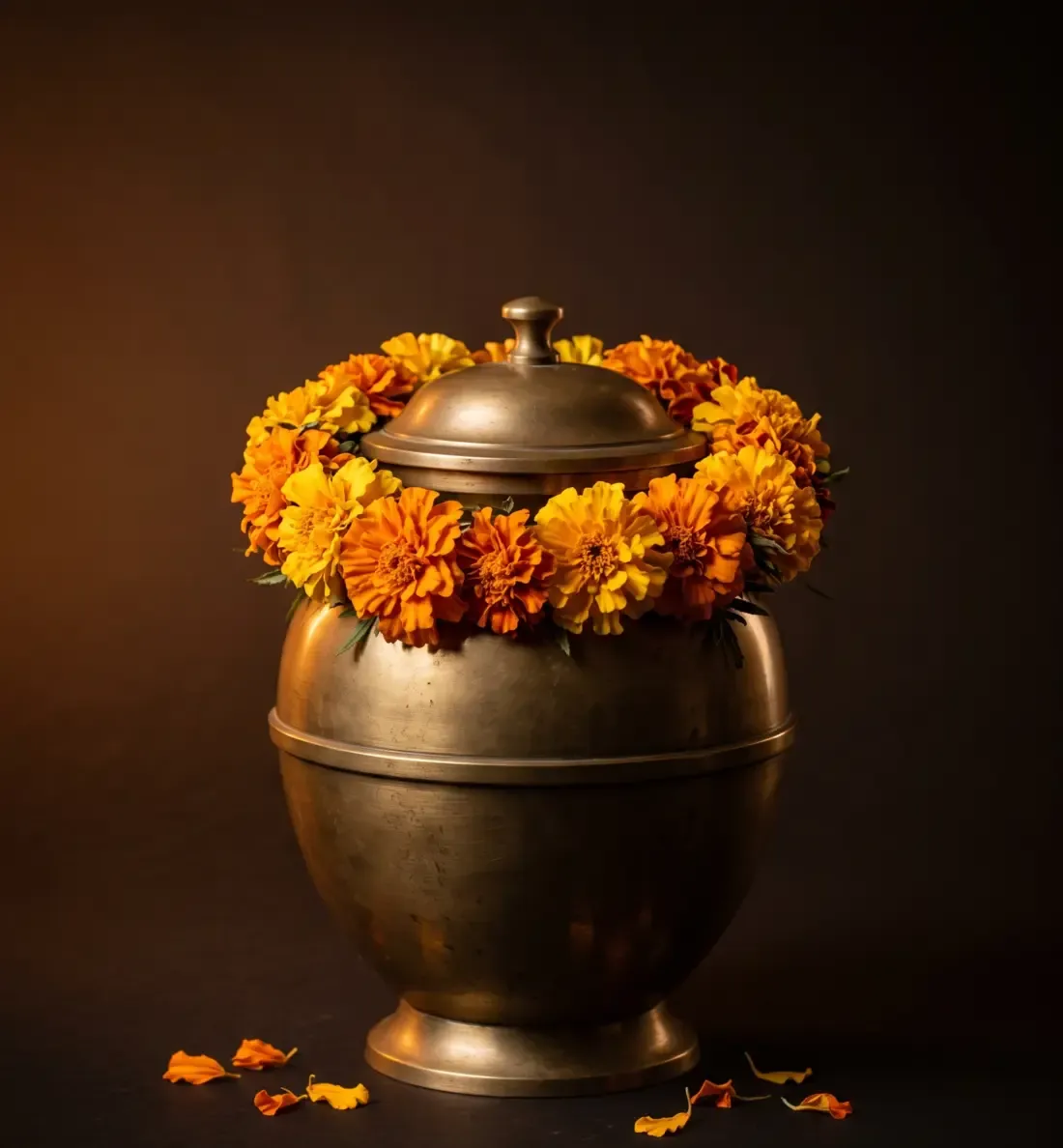
If the ashes live at home, they belong on the altar, and Urnest gets a marigold crown every October. This is the one costume in the Wardrobe that is older than the rest of them put together. Real cempasúchil goes on the altar itself; the crown below is artificial, so it lasts and comes back next year, which is the whole idea.
For the urn
The marigold crown Urnest wears in the photo at the top of this page. Artificial flowers, so it goes back in the box on 3 November and comes out again next year.
Affiliate link: if you buy through it we earn a commission, you pay the same price. See ourdisclosure.
If this time of year is landing harder than you expected, that is normal, and it is allowed. There are people to talk to, free, tonight: they are all here.
Sources: UNESCO Intangible Cultural Heritage listing “Indigenous festivity dedicated to the dead”; Instituto Nacional de los Pueblos Indígenas (INPI), “¿Conoces el significado de los elementos de una ofrenda de Día de Muertos?” (gob.mx); Secretaría de Agricultura y Desarrollo Rural (SADER), “Flor de cempasúchil, belleza espiritual” (gob.mx); ASPCA Animal Poison Control. Checked 2026-10-09. Practice varies a great deal by region, community and family; where your family does it differently, do it their way.