How much ash does a pet make?
Less than you think, and it is all of them. The weight, the volume and the urn size, by body weight, in one table.
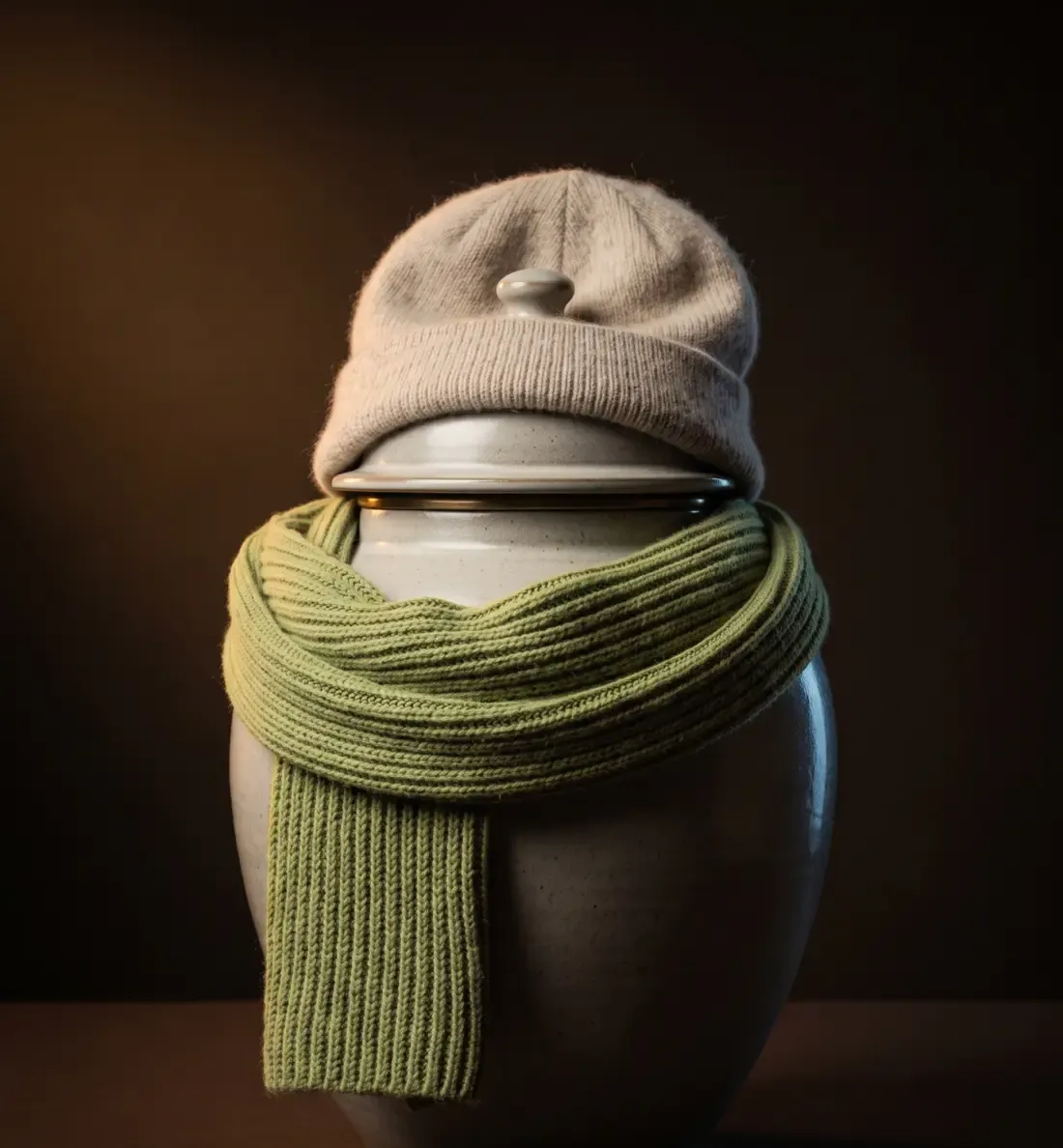
The short answer
Pet crematories generally put the ash that comes back at about 3 to 5 percent of the animal’s body weight. A 10lb cat comes back as a few ounces. A 75lb Labrador comes back as a few pounds, roughly the weight of a bag of sugar. The urn you need is sized by a different, simpler rule: one cubic inch of capacity for every pound the animal weighed, then round up.
The table
| Pet | Ash back | Urn min. | Urn to buy |
|---|---|---|---|
| 5 lbRabbit, small cat | 2–4 oz | 5 cu in | 10 cu in |
| 10 lbAverage cat | 5–8 oz | 10 cu in | 15–20 cu in |
| 15 lbBig cat, small dog | 7–12 oz | 15 cu in | 20–25 cu in |
| 25 lbBeagle, spaniel | 0.75–1.25 lb | 25 cu in | 30–35 cu in |
| 50 lbBorder collie, pit bull | 1.5–2.5 lb | 50 cu in | 60–70 cu in |
| 75 lbLab, golden retriever | 2.25–3.75 lb | 75 cu in | 90–100 cu in |
| 100 lbBig shepherd, rottweiler | 3–5 lb | 100 cu in | 120 cu in |
| 150 lbMastiff, Great Dane | 4.5–7.5 lb | 150 cu in | 180 cu in |
Ash weight is 3–5% of body weight, our arithmetic on the range crematories quote. Urn sizes use the one-cubic-inch-per-pound rule. Breeds are rough examples; use your own animal’s last weight from the vet record, not the breed average. A cubic inch is about a tablespoon.
Why it is so little, and why that is not a rip-off
Every week somebody opens the box from the crematory, sees a small bag of grey-white grit, and quietly wonders whether they got all of their dog. Almost always, yes.
A body is mostly water and soft tissue, and none of that survives a cremator. What is left is the mineral part of the skeleton. The crematory then grinds those bone fragments down, which is why what you get looks like coarse sand rather than the ash from a fire, and why it is pale rather than black. Bigger-boned animals return more than lean ones of the same weight; very old animals with thinner bones can return less. Two cats of the same weight can come back noticeably different.
If you paid for a private cremation, the amount is what it is: it is the animal. If you are worried you were given someone else’s pet or a scoop off a communal pile, that is not a question about weight. It is a question about the crematory, and the ones to ask are onour pet cremation cost page. A good crematory will walk you through how they track each animal and will not be offended that you asked.
And if you chose communal cremation, nothing comes back at all. The box with the paw print on it, if there is one, is not her.
Sizing the urn without getting it wrong
The cubic-inch rule is generous on purpose. Ashes usually come back from the crematory in a sealed plastic bag, and the easiest, least awful way to fill an urn is to put the whole bag in. That needs room. Narrow necks and decorative interiors also eat into the headline capacity. So:
- Use the animal’s actual weight. The last weigh-in at the vet is on the invoice or in the app. An old dog who lost weight at the end needs less than the breed chart says.
- Buy the “comfortable” column, not the minimum. Room to spare costs nothing. An urn that is two tablespoons too small means decanting loose ash over the kitchen sink.
- Demand a stated capacity. A listing that says “suits medium dogs” and gives no cubic inches is guessing. Ask, or buy one that tells you.
- Two pets, one urn? Add the two body weights together. It is a common and lovely thing to do, and it is why people deliberately buy big.
- Not sure? Call the crematory and ask the volume of what they returned. They know it, and telling you is part of what you paid for.
The full version, including which lids really seal and what to pay for wood vs metal vs ceramic, is in the urn buying guide. Our opinions on two cheap pet urns that state their capacity honestly are in the pet urns review.
Sized honestly
Small Pet Urn for Cats, with seal kit$19.99
For cats and small dogs. The title does not state cubic inches, which is a fair knock; ask the seller if your animal was over about 20lb.
Sized honestly
Large Pet Urn for Dogs, 200 cu in, carved mango wood$29.99
States 200 cubic inches on the listing, which covers a dog up to about 200lb, or two medium dogs together.
Affiliate link: if you buy through it we earn a commission, you pay the same price. See ourdisclosure.
Very small animals
Hamsters, budgies, rats, fish, small reptiles. The same percentage applies, which means a 100-gram hamster leaves a few grams, roughly a teaspoon. Before you book a private cremation for a very small animal, ask the crematory directly whether they can guarantee anything comes back, and how they handle it. Better to know before you pay than to get an empty-looking box back. For animals this size, burial in the garden is often the more honest choice.
Splitting them
Because the amount is small, splitting goes further than people expect: a cat’s worth is plenty for an urn on the shelf, a pinch in a pendant and some for the garden. A pendant holds an eighth to a quarter of a teaspoon; our ash pendant review says how much actually fits and how to fill one without wearing half of it. Every other option, priced, is on what to do with pet ashes.
Questions people actually ask
How much ash does a cat make?
Roughly 3 to 5 percent of body weight, so a 10lb cat comes back as about 5 to 8 ounces of ash. It fits comfortably in an urn of 15 to 20 cubic inches.
How much ash does a dog make?
Roughly 3 to 5 percent of body weight. A 50lb dog returns about 1.5 to 2.5 pounds of ash; a 75lb dog about 2.25 to 3.75 pounds. Size the urn at one cubic inch per pound of body weight, plus some room.
What size urn do I need for my pet?
One cubic inch of capacity per pound of body weight before cremation, then round up. A 10lb cat needs at least 10 cubic inches and 15 to 20 is comfortable; a 75lb dog needs at least 75 and 90 to 100 is comfortable.
Why did I get so few ashes back?
Because most of a body is water and soft tissue, which does not survive cremation. What comes back is the bone mineral, ground to grit. A small amount from a private cremation is normal; a small amount is not a sign you were short-changed.
Does fur change how much ash I get?
Not in any way you would notice. Fur burns away like the rest of the soft tissue, and what comes back is bone mineral. A long-haired cat and a short-haired cat of the same weight and bone size return about the same amount.
Is all of the ash my pet?
In a private cremation, yes: your animal is cremated alone and what comes back is theirs. In a partitioned cremation several animals are in the chamber at once, separated, and in a communal one nothing is returned. A little unavoidably stays behind in the chamber, which is why a reputable crematory will tell you how they track each animal and let you ask.
Why are my pet’s ashes different colours?
Mostly because bone is not uniform. Ash can run from white through grey to tan, with the odd darker fleck, depending on the bones, the temperature and what the animal was wrapped in. A blanket or a casket that goes in with them can leave darker specks. Variation is normal and says nothing about whether it is the right animal.
If the box arriving is what knocked you flat, that happens to a lot of people, weeks after they thought they were coping. Pet-loss lines are here.
Sources: return estimates of 3–5% of body weight as published by US pet crematories and funeral.com’s pet cremation guides (which give a 10lb cat as 6–8 oz and a 75lb dog as about 2.5–5 lb); the one-cubic-inch-per-pound sizing rule as stated by urn retailers including Urns Northwest. Checked 2026-10-10. Every animal is different; the crematory’s own figure for your pet beats any table.