What to do with your pet’s ashes
Every real option, what it costs, and who you need to ask. Starting with the one nobody tells you: you can do nothing at all for as long as you like.
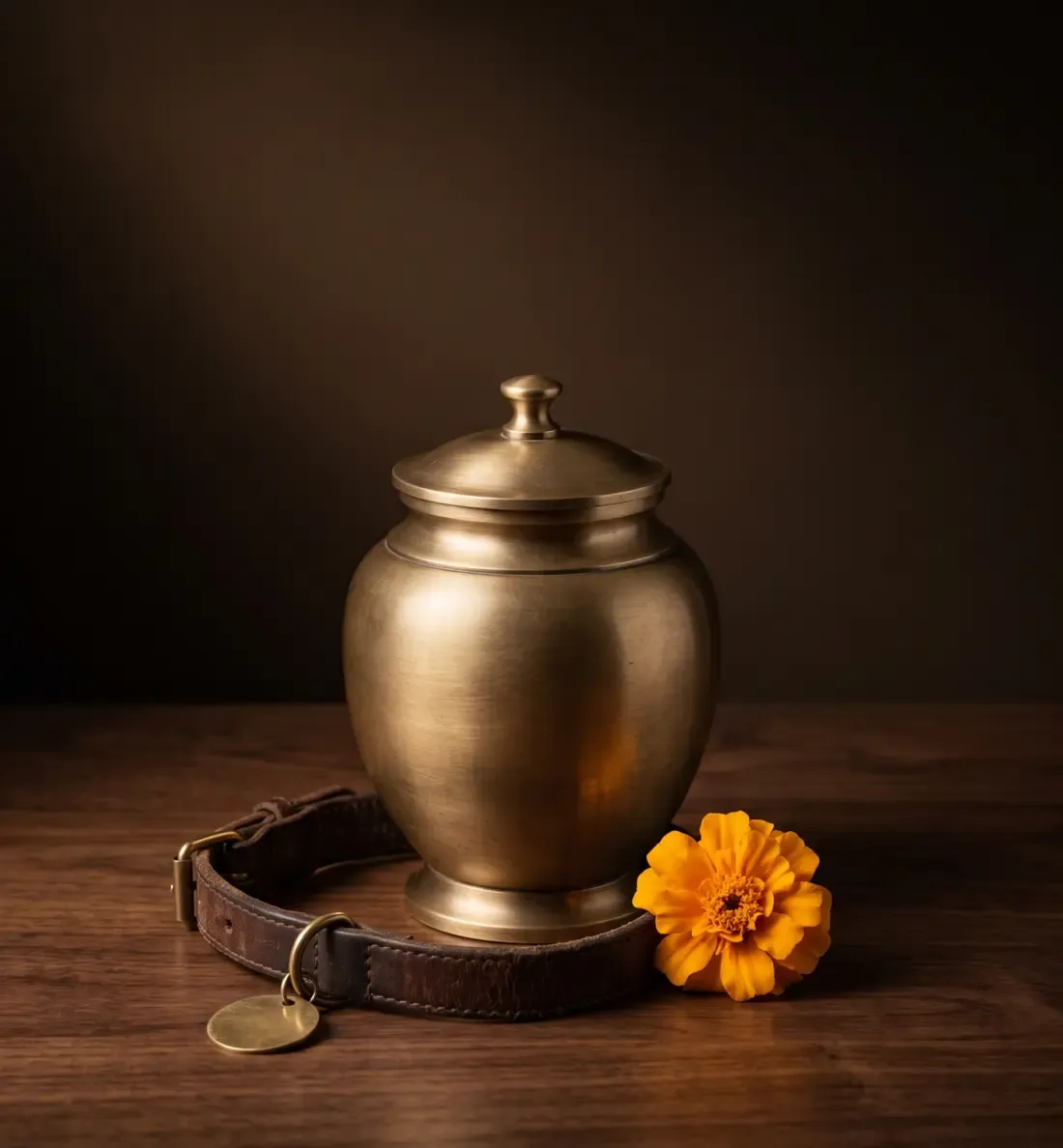
The box comes back from the crematory a week or two later, and it is smaller and heavier than you expected, and now it is sitting on the hall table and you are walking past it every morning. Here is everything you can do with it.
First: leave them in the box if you want
There is no deadline. There is no point at which ashes go off, and nobody is coming to check. Plenty of people keep a dog’s ashes in the crematory’s tin on a bookshelf for ten years and that is a completely fine outcome. If you are not sure what you want, the right decision is to not make one yet. Everything on this page is still available next year.
The quick table
| Option | Cost | Who you need to ask |
|---|---|---|
| Keep them in the box they came in | $0 | Nobody |
| An urn on the shelf | From about $20 | Nobody |
| Scatter on your own land | $0 | Nobody |
| Scatter somewhere else | $0 to a permit fee | The landowner, or whoever runs the public land |
| Bury in the garden | $0, or an urn that rots | Nobody on your own land; your landlord if you rent |
| Pet cemetery plot or niche | Varies a lot; get the itemised list | The cemetery |
| Buried with you, eventually | Whatever your own burial costs | State law and the specific cemetery |
| Split between people, or a pendant | From about $20 | Nobody |
| Turned into stones (Parting Stone) | $1,195 for a cat | Nobody |
Keep them
The most common choice and the least complicated one. The only real decision is whether the crematory’s container is good enough (often it is a perfectly decent tin or wooden box) or whether you want something you chose.
If you are buying an urn, the thing to get right is the size, in cubic inches: one per pound of body weight, then round up. The full table is onhow much ash a pet makes. A pet urn should not cost what the vet’s brochure says it costs. Our pet urns reviewcovers two that state their capacity honestly, for under $50.
Scatter them
Pet ashes are scattered under the same practical rules as human ashes, and those rules are almost entirely about whose land it is. On your own land, do what you like. On somebody else’s, ask them. On public land, ask whoever runs it: a national park, a state agency, the city. All of that, with real permit fees, is on where it’s legal to scatter ashes.
One honest caveat: the EPA’s burial-at-sea permit, with its three-nautical-mile rule, is written for human remains. We could not find a federal rule that specifically addresses pet ashes in the ocean. If you are doing it from a boat, follow the human rule anyway; it is the safest version of “allowed” there is.
Practical bits nobody mentions until it is too late:
- Check the wind. Stand with it at your back. Then check again. Everybody has heard the story; nobody wants to be in it.
- Pour low, don’t throw. Ashes are heavy grit, not smoke. Pour close to the ground or the water and they go where you meant them to.
- Keep a little back. Scattering is permanent. Setting aside a spoonful in a small keepsake first costs nothing and is the thing people most often wish they had done.
- The dog park is somebody’s. Usually the city’s. Ask, or scatter quietly at the edge rather than in the middle where people throw balls.
Bury them in the garden
Much simpler than burying a body. There is no decomposition, no scavenger problem and no euthanasia drug to worry about the way there is with a body (that warning is onthe cat page, and it matters). The Funeral Consumers Alliance notes that cremated remains are not treated as a health hazard.
- Under a tree, not on the roses. Cremated remains are strongly alkaline and very high in sodium, which can burn young plants. Gardening Know How’s advice is to spread them thinly around established trees and shrubs, or mix them with a soil amendment made for the job and let it sit before planting. A heap of ash in the root ball of a new sapling is how you kill the memorial tree, which is a special kind of awful.
- A biodegradable urn lets you bury the whole thing in one go, no handling the ashes at all.
- You might move. Scattered ashes are part of the garden and that is fine. A buried urn stays with the house. If that would bother you, scatter, or bury only some.
- Renting? Ask the landlord before digging, or scatter instead.
A pet cemetery
Pet cemeteries sell plots for cremated remains and niches in walls, and the price swings a lot by region and by how much “forever” is included. We are not going to quote a national figure we cannot back up. What we will tell you is how not to get fleeced: ask for the priceitemised. The plot, the opening and closing of the grave, the marker, and the “perpetual care” fee are separate charges, and the headline number on the website is often only the first one. Ask what happens to the plot if the cemetery closes, and get the answer in writing.
Have them buried with you
A lot of people want this and assume it is either automatic or impossible. It is neither. It depends on your state, and then on the specific cemetery.
- New York changed the law in 2016 so that not-for-profit, non-religious cemeteriesmay allow a pet’s cremated remains to be buried with its owner. The pet has to be cremated, the cemetery has to opt in, and religious and for-profit cemeteries are not covered.
- Virginia allows cemeteries to set aside clearly marked sections where people and pets are buried alongside each other, but not in the same grave, crypt or niche.
- Everywhere else, the cemetery’s own rules are what you are up against. Ask the one you will actually be buried in, before you need it.
Whatever the answer, write it down. Put the dog’s tin and the instruction in the same place as the rest of your end-of-life paperwork, and tell the person who will be arranging your funeral. The most common way this wish fails is that nobody knew it existed. Our guide tothe first 48 hours after a death is a good one to leave for them, too.
Split them
Because there is less ash than you expect, splitting is easy to over-do. A cat’s worth will still cover an urn, a pendant and a handful for the garden. Two cheap tools make it painless: a keepsake set with a funnel, so everyone in the family gets some, and a pendant, which holds an eighth to a quarter of a teaspoon. Our ash pendant review has the honest version of what fits and how to fill it.
Useful, not precious
Marble-Finish Keepsake Urn Set of 4, with funnel
For splitting a pet between the people who loved them. The funnel is the part everybody forgets and the part that matters.
Useful, not precious
Stainless Steel Cremation Ash Pendant
Holds a pinch. Stainless, so it survives daily wear. The same job as the $300 version in the brochure.
Useful, not precious
Bamboo Scattering Urn, screw-on lid
For carrying them to the place and scattering from it, or for burying whole under a tree.
Affiliate link: if you buy through it we earn a commission, you pay the same price. See ourdisclosure.
Turn them into something else
This is where the money gets silly, so we will go slowly. Parting Stone turns cremated remains into a handful of smooth, solid stones you can hold. On 2026-10-10 its listed price for a cat was$1,195, for an average of 2 to 10 stones, with a turnaround of 10 to 12 weeks. That is a real product doing a real thing, and some people find holding a stone a great deal easier than looking at a bag of grit. It is also the price of several years of cat food. Both are true.
Glass, jewellery and lab-grown “memorial diamonds” are their own rabbit hole, with markups to match. Every kind of jewellery is priced in ourcremation jewellery guide, andwhat an ash diamond really costs gets a page of its own, because the answer is a lot.
Put them on an ofrenda
Plenty of families now set a place for their animals during Día de Muertos (the pet day is a modern custom, and our guide says so), and building a small ofrenda with a photo, their bowl and a marigold is one of the gentlest things you can do with the first year. How to do it, and how to do it respectfully if it is not your tradition:building an ofrenda, including one for a pet.
If you can’t decide
Then don’t. Put the box somewhere you choose, not somewhere it landed, and come back to this in a few months. Grief for an animal is real grief, it lasts longer than people around you will expect, and you are allowed to take your time over the last decision you get to make for them.Pet-loss support lines are here if the box on the shelf is harder than you thought it would be.
Sources: Funeral Consumers Alliance on scattering and the legal status of cremated remains; EPA burial-at-sea general permit (40 CFR 229.1), which covers human remains; Gardening Know How on the pH and sodium content of cremated remains; reporting by NBC New York on New York’s 2016 pet-burial law; ElderLawAnswers on Virginia’s 2014 law; Parting Stone’s published price for cat solidified remains. Checked 2026-10-10. Laws differ by state and cemetery rules differ by cemetery; ask before you dig or buy.